ORGANIZATIONAL DEBT
Why are AI investments underdelivering? What’s actually in the way?
WHY IS NOBODY ASKING THIS QUESTION?
Your organization has probably spent the last couple of years deploying AI. New tools. New platforms. New vendors. Pilots in finance, operations, customer service, strategy. Announcements to the board about the transformation underway.
And yet, if you’re being honest, in most cases the results are underwhelming. The technology isn’t what’s failing or blocking results; but rather the organization itself.
What role is your organization playing in enabling or blocking AI advancement?
The real obstacle to capturing value from AI is not your tech stack. It is the accumulated weight of structural decisions your organization has made over decades — decisions about layers, roles, decision rights, governance, and leadership — that made sense in a world of information scarcity and now don’t.
We call this Organizational Debt. Until you address it, no amount of AI investment will deliver what you’re expecting.
WHAT IS ORGANIZATIONAL DEBT?
Software engineers have long understood the concept of technical debt — the accumulated cost of shortcuts, legacy systems, and quick fixes that seemed reasonable at the time but compound into a structural liability. Organizational debt is the same phenomenon applied to how companies are designed.
Every organization carries it. It accumulates through mergers that layered two org charts on top of each other without reconciliation. Through leadership changes that added new functions without retiring old ones. Through decades of decisions about who approves what, who reports to whom, and which roles exist — decisions made in response to specific moments that are long since past.
In a pre-AI world, this debt was expensive but manageable. Layers of management aggregated information because someone had to. Decision rights were ambiguous because the cost of that ambiguity — a slower decision, an extra meeting, a politically negotiated compromise — was bearable. Roles were defined around tasks that humans did because humans were the only option.
AI changes the cost-benefit calculation entirely. When agents can aggregate information instantly, management layers built for that purpose become pure overhead. When AI systems need explicit decision parameters to function, ambiguous decision rights become a hard stop, not a minor inefficiency. When AI absorbs the analytical tasks that junior employees did to develop expertise, your talent pipeline quietly breaks.
AI does not just augment your organization. It illuminates every place where your organization was already broken.
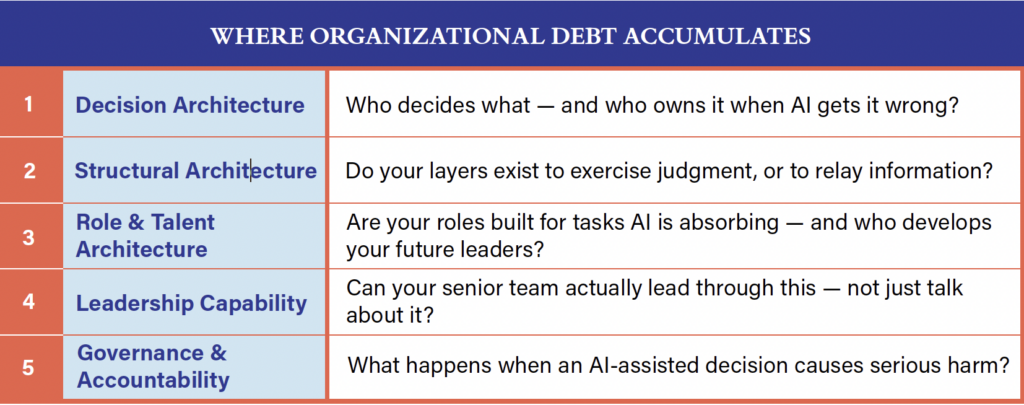
THE FIVE DEBTS AI WILL EXPOSE
1. Decision Architecure
Ask any leadership team who decides what in their organization and you will get confident, broadly consistent answers. Ask them to write it down in detail and the picture gets murkier. Ask them what happens when an AI system makes a consequential decision and suddenly nobody is quite sure.
Most organizations have never explicitly designed their decision rights. They have accumulated them — through precedent, politics, and the path of least resistance. This was costly but survivable when humans were navigating the ambiguity informally. AI agents cannot navigate ambiguity. They need parameters. Where parameters don’t exist, deployments stall, produce unowned outputs, or quietly create accountability gaps that nobody notices until something goes wrong.
2. Structural Architecture
The average large enterprise has four to six management layers between the CEO and the front line. Most of those layers were built — whether anyone admits it or not — to manage information flow. To aggregate data from below, translate strategy from above, and coordinate across functions that couldn’t see each other directly.
AI does all of that in seconds. Which means management structures built around information scarcity are not just inefficient in an AI-augmented world — they are structurally redundant. The organizations that redesign around this will be faster, cheaper, and more responsive. The ones that don’t will carry an overhead burden their leaner competitors won’t.
3. Role and Talent Architecture
There is a pipeline crisis forming in slow motion inside most large organizations, and almost nobody is paying attention to it. The junior analyst roles — the ones where people historically built the pattern recognition and judgment that made them valuable senior leaders — are being quietly absorbed by AI.
The problem is not just that those people need new jobs. The problem is that ten years from now, you will go looking for leaders with deep functional expertise and find a generation that never got the formative experience. The talent pipeline does not break visibly. It empties silently, and by the time the shortage is obvious it is already expensive to fix.
The talent pipeline doesn’t break visibly. It empties silently — and by the time the shortage is obvious, it’s already expensive to fix.
4. Leadership Capability
The skills that got your senior team to where they are — deep functional expertise, political navigation managing through information control — are becoming less valuable, not more.
The AI era rewards di erent things: comfort with genuine ambiguity, the ability to lead human-AI workflows, willingness to redesign rather than optimize, and the credibility to take accountability for decisions that AI influenced but humans owned.
Most leadership development programs have not been recalibrated for this. They are still building the skills of the last decade. The gap compounds quietly until a transformation fails and everyone wonders why the team couldn’t execute.
5. Governance and Accountability
This is the most urgent debt and the most under addressed. When an AI-assisted decision causes a customer harm, a regulatory breach, or a reputational crisis — who is accountable? Most organizations, if pressed, cannot answer that question clearly. They have AI governance policies that are either nonexistent or were written for a world of simple automation and have not caught up with agentic AI.
Regulators are moving. The EU AI Act is not the last word — it is the first. Sector-specific rules are following. The organizations that build governance frameworks proactively will have a structural advantage over those that retrofit them after the first crisis. The window for getting ahead of this is narrowing.
THE UNCOMFORTABLE TRUTH ABOUT YOUR AI STRATEGY
Most AI transformation programs are technology-led. A CTO or Chief AI O icer owns the roadmap. The organizational questions — structure, decision rights, talent pipelines, governance — are treated as change management: the human side of a technology initiative, to be handled by HR and communications.
This framing gets it backwards. The technology is the easier part. The harder part — the part that determines whether AI investments actually deliver — is organizational. And it requires the same disciplined, structured approach that you would apply to any major strategic redesign.
The organizations that will win the AI era are not the ones that deploy fastest. They are the ones that use AI as a forcing function to retire decades of organizational debt and redesign for the world they are actually operating in. The technology gives you permission to do what should have been done years ago. The question is whether you will use it.
The shared ownership of AI extends to the C-Suite and Business. It’s not just an IT nor HR responsibility.
WHERE TO START
Addressing organizational debt is not a single initiative. It is a structured diagnostic and redesign process that runs alongside — and often ahead of — your AI deployment roadmap. Three questions are worth asking immediately:
-
-
Have you explicitly mapped your decision rights — not as they are supposed to work, but as they actually work — and identified where AI accountability is unresolved?
-
Do you know which roles are most exposed to AI augmentation in the next 24 months, and have you designed a developmental pathway that doesn’t depend on work AI is absorbing?
-
Could you answer a board member who asked: if an AI-assisted decision caused significantharm tomorrow, who owns it — and what happens next?
-
If the honest answer to any of those three questions is ‘no’ or ‘I’m not sure,’ you have organizational debt that is actively limiting what your AI investments can deliver. The good news: it is diagnosable, addressable, and the organizations that get ahead of it will compound that advantage for years.
Does this resonate with what you are experiencing?
We’d love to talk.